|
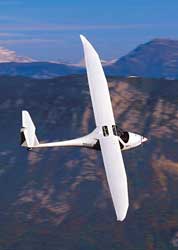
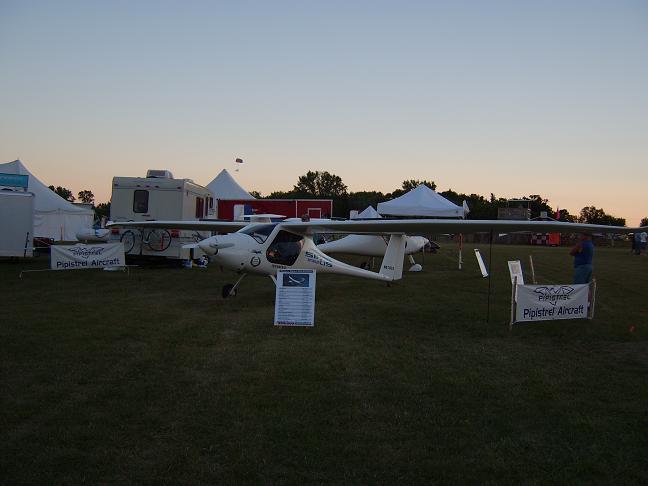
| Pipistrel Sinus 912 at Oshkosh 2005 |
I first saw the Pipistrel aircraft at Oshkosh EAA Airventure in 2005, and was immediately
taken with it. It was the evening of our last day before we finally wandered down to the ultralight area, and nobody
was around, but I picked up a flyer. I later checked the web site, contacted Vance Turner, a Pipistrel dealer located
near Sacramento, CA,
and arranged a demo flight while passing through on a business trip. At that time,
there had been a handful of Pipistrel aircraft imported to the US, but the plane was not available as a certified Light Sport
Aircraft, nor had the kit been evaluated for compliance with the FAA 51% rule for experimental amateur-built certification.
Therefore, all the Pipistrel aircraft flying in the US at the time were registered as Experimental Exhibition-Air Racing.
I was not particularly intrested in operating an aircraft in that certification category, so I inquired about the idea of
getting a Pipistrel kit evaluated for experimental amateur-built certification. After an exchange of several e-mails
with Vance, the Pipistrel factory and Pipistrel USA, it was arranged that I would purchase the first Pipistrel kit to be imported
into the USA, that I would participate in the FAA evaluation process, and that I would assist in updating the builder documentation,
augmented by this web site.
All this was accomplished by March, 2006, and I sent a deposit to the factory
to get things underway. Meanwhile I began to explore with Vance and other Pipistrel dealers various schemes to get my
kit shipped to the US, hoping to be able to share the shipping costs with one or two other deliveries. I also contacted
the local EAA for guidance on how to pursue the FAA kit evaluation. The EAA directed me to the Seattle area FAA Manufacturing
Inspection Discrict Office (MIDO), and I initiated contact there.
Mary and I were already planning a trip to Europe
in April, so we added a visit to Slovenia in order to see the Pipistrel factory and learn something about the kit components
and the construction process. We rented a car in Milan to tour some of northern Italy, so it was easy to make the short
trip just across the border to Ajdovscina. Ivo Boscarol and everyone at Pipistrel were very gracious and treated us
like visiting royalty. I was extremely impressed with the professionalism and the technical competence of the factory
people, the clean, modern facility, and the quality of the products. The quality control, inventory management, configuration
management, etc., are equivalent to anything I've seen in the US aerospace industry. The designs are all CAD-based,
the parts storage and retrieval is all automated, and the entire factory is completely environmentally contained, with sophisiticated
filtration and scrubbers for all the water and gaseous by-products, such that they are certified as releasing no contaminants
of any kind into the environment.
|
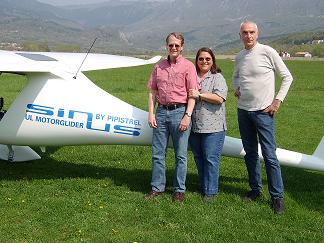
| Paul and Mary with Ivo Boscarol, CEO of Pipistrel Aircraft |
I flew three times with the factory pilot, Tine Tomazic. We flew up over the steep mountain ridges north
of the factory, shut down the Rotax, feathered the propeller and soared the ridge for 30 minutes or so before restarting the
engine and returning to the field. We also did a little sight-seeing over the beautiful Slovenian countryside.
My second and third flights were spent in the pattern getting a feel for the plane and the management of power, flaperons
and spoilers in the takeoff and landing phases.
Mary also went for a flight with Tine, which says something
for the confidence we gained in the people at Pipistrel. Mary has never flown in a small aircraft with anyone except
me, but she really loved the airplane, and Tine even shut the engine down on that flight, including a landing in glider configuration.
I was a bit apprehensive about a potential lanquage barrier, since I don't have a clue about the Slovenian language.
My wife is fluent in Spanish, which seems to work just about everywhere in Europe, but I didn't know if that would help in
Slovenia. In the end, English worked just fine. The people we spoke with at the factory all used excellent English,
which seems to be their standard common language for conducting international business. Tine, a graduate engineering
student, spoke English very well, and even had what sounded like an American influence in his accent, so I
assumed he must have received some of his education in the US. To the contrary, he has never been to the States, and
said that he just learned English "here and there". I suspect his language training was actually somewhat
more formal, but it only served to emphasize the general lack of real language skills that Americans acquire.
In
preparation for our visit, the factory had my kit laid out for examination. The more that I saw, the more impressed
and enthusiastic I became. The design was well-conceived, the quality and workmanship evident in the individual components
was excellent, and the construction steps were reasonably well documented in the kit manual.
So, with my favorable
impression of the aircraft confirmed, and feeling pretty confident about the kit and the construction process, we returned
to Seattle to tackle the challenges of shipping and FAA evaluation.
|
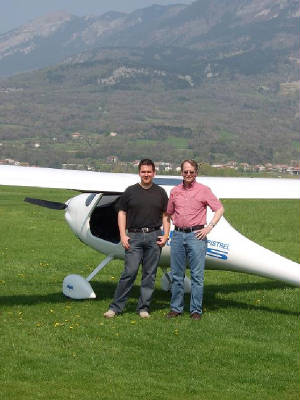
| Paul and Tine Tomazic at Pipistrel factory airstrip |
|